
ECONOMIC MYOPIA
WHY THE GOVERNMENT CAN ONLY SEE THE TREES AND NOT THE FOREST

A little bit about me before we start. I am British and will therefore write from that perspective. I am just an ordinary woman in her 50s but I have a wealth of experience and some strong opinions. However, to paraphrase Groucho Marx, if you don’t like them, I have others. I write from a personal point of view but will do the necessary research to back up my ideas. I am a Christian, feminist, left-handed vegetarian in my fifties, which means I am well-practised at challenging conventions.
I was going to write about Christian Nationalism and Nigel Farage’s ties to it this week. I will do that at some point, but decided, instead, to look at economic policies and why the public spending on services that support us has been hollowed out and the consequences of that.
This is very personal to me. I spent over twenty years working as a nurse in the NHS which, for me, was an absolute privilege. Also, I am disabled. I have multiple mental and physical conditions that mean I am unable to work, much as I would love to. According to the DWP I am faking being sick, and they removed my PIP with the click of a “print letter” button. What they fail to understand is that I am not faking being sick. What I am doing is faking being well.
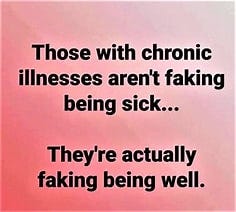
When we are unwell, do we not try to live our lives as if we weren’t? Do we want to live a normal life, just like we used to? After many years of working, then being a widowed single mother and trying to hold things together for myself and my boys, while grieving, having depression, anxiety, an eating disorder and undiagnosed AuADHD, I buckled under the strain, and was hospitalised three times in psychiatric units. On top of that, I caught Covid multiple times between 2021 and 2024 and have long covid. But my head forgets that I am not 30 years old anymore and I try to do tasks as if I was and that none of those conditions affect me. Who wouldn’t?
My Personal Independence Payment allowed me to live with a certain amount of dignity, including being able to run my car and not having to worry about any utility bills. Dr Frances Ryan wrote “Crippled” a devastating indictment on the effects of austerity and the demonisation of disability. (See link to the book and a video of her explaining the message she wrote about below). The introduction of “austerity” in 2010, has wreaked havoc on people’s lives. The cost of austerity: How UK public spending cuts led to 190,000 excess deaths - LSE Inequalities Coupled with Thatcher’s legacy, austerity has been a disaster for ordinary citizens.
OW THIS RELATES TO THE TITLE
I spoke about the country’s finances being likened to a household budget in my first post. However, a household cannot print extra money, or raise taxes or sell off more of the family silver. There is no credit card that is maxed out, apart from our own personal ones. Yet successive governments have slashed spending on welfare and public services, without looking at the true cost of these policies. The government have underfunded the NHS until it became a shadow of its former self. Which leads to people being on long waiting lists for surgery and initial consultations for physical health related conditions and even longer for mental health issues. Then they moan that too many people are claiming sickness benefits. Any investment in the NHS would have paid for itself by now because more people would be well and working. Disability and sickness have been made into a personal failure, rather than something that can happen to anyone. This is known as the “Tragedy Model”.
“The Tragedy Model, also known as the Medical Model, views disability as a personal tragedy or a medical problem that resides within the individual. According to this model, a person’s disability is something that needs to be fixed or cured. The focus is on the individual’s limitations and what they cannot do. Key Characteristics of the Tragedy Model: • Sees disability as a defect or illness. • Emphasises medical intervention and rehabilitation. • Views disabled people as passive recipients of care.” Taken from Analysis_The Tragedy Model vs the Social Model of Disability.pdf
Which is then used to justify cuts to sickness benefits, whether you are working or not.
THE ELEPHANTS IN THE ROOM
Poverty has also been deemed the fault of the individual. “Work harder” people are told, totally ignoring the fact that many people are working flat out in one or more jobs. These jobs, however, are either insecure so a person doesn’t know how much they will earn from week to week and is dependent on how many hours their employers offer them or underpaid. Think about care work. Despite it not necessarily needing any sort of qualification, it is actually highly skilled work. A lot of it is being done by immigrants who, given the current rhetoric around scrapping indefinite leave to remain, means there will be fewer people to look after your Mum when she can no longer care for herself. The Gig economy causes Major Headaches (can you picture him now? A person in full army uniform with their head in their hands and begging for some paracetamol? Yes, it is still called paracetamol in the UK but if you are posh, it’s Panadol) for people should you earn slightly more than you had anticipated. The system wants to grab some of it back immediately, rather than looking at trends over weeks or months. It also ignores the fact that deregulation has allowed big employers to pay little more than the minimum wage, so people need to top up their wages with Universal Credit. This is, apparently, the fault of the worker, and not the employer. As I see it, the Government’s welfare spending isn’t on the individual claimant in these cases. It is subsidising businesses so they can continue paying their employees as little as possible and therefore maximise their profits. Add to that wage stagnation and the fall out from the “B”-word and we have ourselves a perfect storm.
Another elephant (is it in the room with you now? Can you see it? Why, yes, it is and yes, I can) is the privatisation of pretty much everything. We are paying much more for basic amenities like gas, electricity, water, public transport and council tax (because successive governments have slashed spending on local councils, while still expecting them to fund those little luxuries in life, like bin collections, social care and special educational needs provision) and getting worse service. This is because the state doesn’t see it as their job to provide these and why not let it make money if it can?
Ooh, I can see one more. Education. While the government are expecting legal immigrants to be highly skilled (whatever their definition of that is, probably good at tech/AI, lawyers, doctors and so on) and earn a certain amount of money and volunteer in their spare time, whilst paying for the visa they were issued with and the NHS surcharge, what about the children? We are sold a myth of meritocracy, and that if you work hard at school and are talented enough you will rise through the ranks when you work throughout your career. But what if your school is literally falling down and crumbling due to RAAC? There are not enough teachers and those that remain (God bless them) are stretched to their limit. Schools can no longer afford sufficient and well-trained teaching assistants to relieve the pressure on teachers and add value to students’ learning. From the age of 5 to 18, children need to feel valued and safe in order to learn. Oh, and not hungry either. Is this an environment conducive to learning, do we think? We also have to consider the long lasting consequences of lockdowns on our young people. Many of us found the whole thing traumatic due to mixed messages and not really knowing what you could or couldn’t do at any given time, though, of course, if you were a politician, parties were acceptable behaviour, and anyone in the VIP lane proved the adage “never let a crisis go to waste”. But our children bore the brunt of it, in terms of missed education, lack of peer support and lost social skills.
Then, if a young person wants to get a university education, they do so in the full knowledge that they will graduate with at least £27,000 worth of debt, and that’s just the tuition fees, but with no guarantee of a secure, well-paid career ahead of them.
CONCLUSION
Successive governments have tried to balance the imaginary books by selling off the country’s assets which has led to a hollowed-out welfare system. It is like the owner of a forest deciding that selling a few trees won’t hurt. But then realising they want to sell a few more because it made a tidy sum and the trees were no longer their responsibility. Then a few more go, because, well, money. And all of a sudden, there are no more trees to sell and the forest, that basically paid for itself, supported many other lives -plants and animals – and added value to the environment, has gone.
The forest is the country. The trees are the public services that have been sold or underfunded. The lives the forest supported are us. And the powers that be wonder why we aren’t all cheering with gratitude and helping the economy grow, because they fail to join the dots and see that no one can spend money they don’t have. Or work in jobs that don’t exist. Or in jobs where employers can’t or won’t make reasonable adjustments for disabled people. And now, the cruelty seems to be the point. There is much more to be said about this but I will save it for another rant post.
Thank you for reading my work.
While I am here, I highly recommend the following Substacks:
Because each of them explain things much better than I can.
REFERENCES
WEBSITES
DWP benefit rates compared to other countries dire, report finds
Access to Work, the best kept secret? | Disability Rights UK
Analysis_The Tragedy Model vs the Social Model of Disability.pdf
Poverty and the Rise and Fall of the Welfare State in Britain, 1900 to the Present | Society
Welfare reform bill: what changes did the government make to get it over the line?
All DWP Universal Credit claimants warned ‘even if you’re working full-time’
What is RAAC concrete and why is it a safety risk? - BBC News
Exclusive: First ever drop in TA numbers a ‘serious problem’ | Tes Magazine
SUBSTACKS
The Ceaseless Snip-Snip-Snip of a Dying State - by The Bear
BOOKS
Crippled: Austerity and the Demonization of Disabled People | Verso Books
VIDEOS
Thanks for writing this, it clarifies a lot. Your personal story makes the hollowing out of services so palpable. It makes me wonder about the flawed models driving these economic policie. Such an important perspective.
Govts have also failed to recognise that just because they decide not to fund something it doesn’t mean that the need for that funding goes away. It usually means that that need just shows up in another part of the system (usually when it is more difficult and more expensive to address) and therefore “costs” all of us more money in the long run.
The reality of austerity for me was that not only did it not save us any money but it completely fractured and undermined a social and economic system that was supporting all of us in such a way that we end up with a more expensive set of public services that don’t work very well.
Cameron, Osborne and Clegg have a lot to answer for.